
Case Study
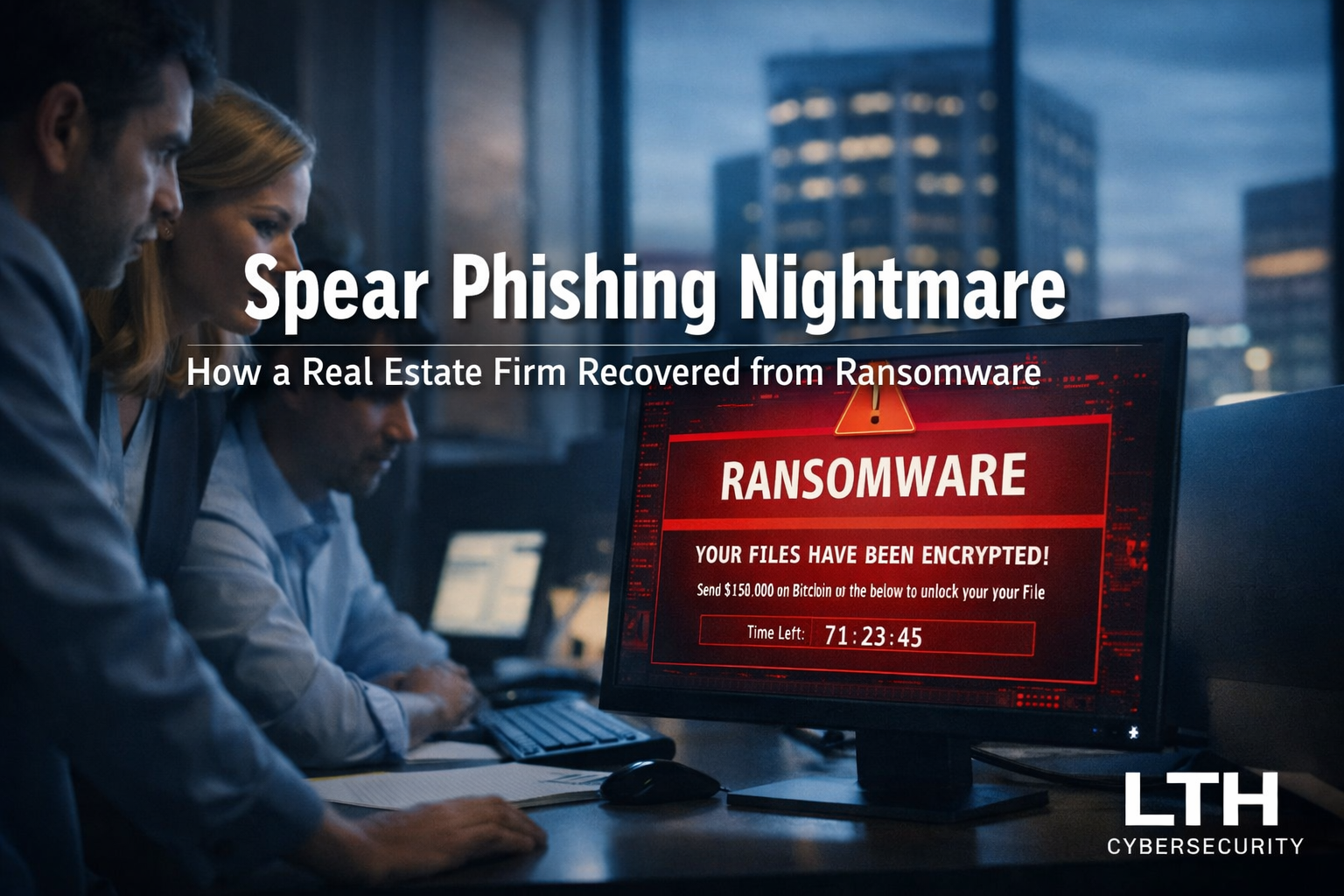
Spear Phishing Nightmare:
How LTH Cybersecurity Helped a Real Estate Firm Recover from Ransomware
The Vulnerable Target
A mid-sized real estate firm relied heavily on email for daily operations. Lease negotiations, agreements, financial documents, and legal communications were exchanged regularly between:
-
Property Management
-
Finance
-
Legal
-
HR
The organization had basic IT support but lacked advanced monitoring, email filtering, and endpoint detection capabilities.
Email was trusted.
Security was assumed.
Zero Trust was not implemented.
The Phishing Trap
A property manager received what appeared to be a legitimate internal email from “IT Support.”
The message requested an urgent credential verification. The employee followed the instructions and clicked the link.
Within minutes:
-
Credentials were harvested
-
Ransomware was silently deployed
-
Email access was compromised
The attacker leveraged the compromised mailbox to target Finance and Legal teams.
The Breach Unleashed
Employees suddenly lost access to shared files.
A ransomware message appeared demanding Bitcoin payment.
Operations halted. Chaos spread across departments.
Critical impacts included:
-
Lease renewals delayed
-
Invoices disrupted
-
Legal documentation inaccessible
-
HR data exposed
The IT team confirmed the worst:
This was a coordinated ransomware attack initiated through spear phishing.
The Awakening
The firm’s leadership realized:
-
Their email security controls were insufficient
-
There was no 24/7 monitoring
-
No role-based access enforcement
-
No Zero Trust architecture
-
Limited cloud backup resilience
Hiring a full internal security team was financially unrealistic.
They needed a managed security solution — immediately.
That’s when they engaged LTH Cybersecurity.
The Redemption: LTH Cybersecurity Response
Through our white-label managed security partnership, LTH deployed enterprise-grade protections, including:
24×7 Managed Endpoint Detection & Response (MEDR)
Continuous monitoring to detect and contain active threats.
Advanced Email Security & Filtering
Blocking phishing attempts before reaching user inboxes.
Role-Based Access Controls
Restricting lateral movement across departments.
Zero Trust Architecture
No device or user is automatically trusted — verification required at every step.
Secure Cloud Backups
Ensuring business continuity even if systems are encrypted.
Ongoing Security Awareness Training
Reducing human-risk factors across the organization.
The Aftermath & Recovery
Within weeks:
-
Systems were restored
-
Monitoring was active 24/7
-
Email compromise attempts were blocked
-
Backup validation procedures were tested
-
Department access was segmented
Most importantly, leadership gained visibility into their cybersecurity posture for the first time.
The Lesson Learned
Ransomware exposed what traditional IT often overlooks:
Cybersecurity is not optional infrastructure — it is operational survival.
This incident highlighted the necessity of:
-
Zero Trust security models
-
Managed detection and response
-
Email security layers
-
Continuous employee training
-
Backup validation strategies
The firm now actively advocates for managed cybersecurity within its industry network.
Why This Matters for Saskatchewan & Canadian Businesses
Many real estate firms, nonprofits, Indigenous organizations, and SMBs across Saskatchewan operate exactly like this firm did:
-
Heavy email reliance
-
Limited internal security resources
-
Assumption-based trust models
-
No 24/7 monitoring
LTH Cybersecurity delivers enterprise-level protection through a managed partnership model — without requiring clients to hire full internal security teams.