
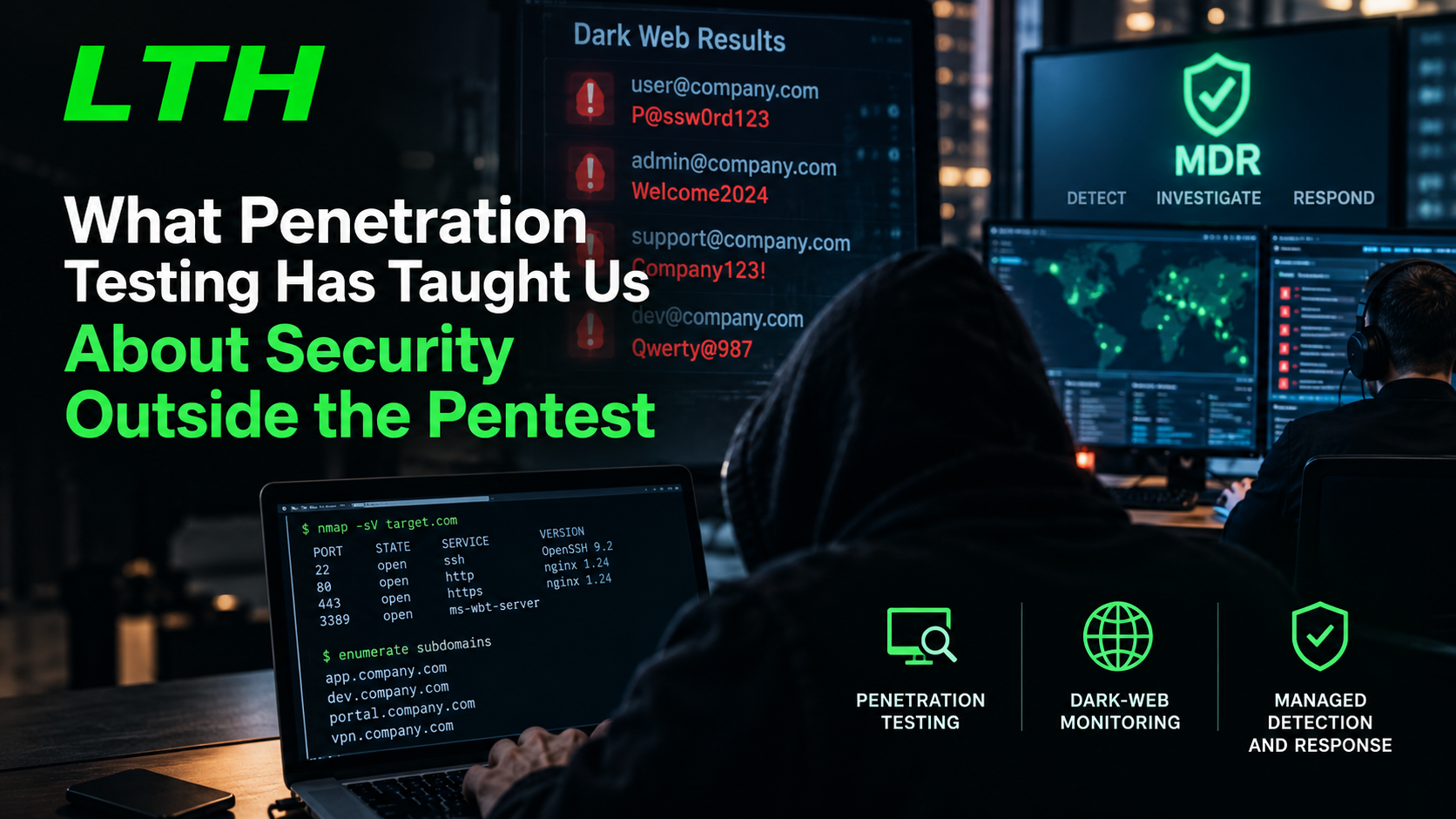
From Dark Web to Pentest: What Attackers Can Discover About Your Business
At LTH Cybersecurity, we do a lot of penetration testing.
We test web applications, APIs and infrastructure, and sometimes we approach a target with very little information. In a black-box penetration test, that’s the point. We want to understand what an attacker can discover and potentially exploit from outside the organization.
But penetration testing has also taught us something important: an organization’s attack surface doesn’t necessarily stop at its applications, servers or network.
Sometimes credentials and other information are already exposed elsewhere.
That’s where dark web monitoring and penetration testing can start telling different parts of the same story.
What Does a Black-Box Penetration Test Actually Look For?
A black-box penetration test starts with limited information about the target.
Before attempting to exploit vulnerabilities, we need to understand what’s exposed.
That can include domains, subdomains, web applications, APIs, external services, technologies and publicly available information associated with the organization.
We then look for potential attack paths.
That might mean identifying an access-control vulnerability, authentication weakness, exposed service, vulnerable application or another way an attacker could gain access.
But sometimes the information available to an attacker extends beyond the organization’s own infrastructure.
Dark Web Credentials Can Become Part of the Attack Surface
Compromised credentials can appear in breach data, stealer logs and other datasets available to cybercriminals.
That matters during penetration testing because attackers don’t necessarily need to discover a sophisticated vulnerability if they already have information that could help them get through the front door.
Imagine approaching an organization from the outside and discovering that an employee’s credentials have already been exposed.
The security question changes.
Instead of only asking:
“Can we find a vulnerability that gets us in?”
We also need to consider:
“What information does an attacker already have?”
This is one reason dark web monitoring can complement penetration testing.
Finding Credentials on the Dark Web Doesn’t Automatically Mean a Breach
A dark web credential exposure needs context.
Finding an organization’s email address or credentials in compromised data doesn’t automatically mean its network has been breached.
The data could be old.
The password may have already been changed.
The employee might no longer work there.
The account might not even exist anymore.
But if the credentials are current, that’s a very different situation.
The response could involve resetting passwords, terminating active sessions, reviewing authentication activity, enforcing multi-factor authentication and investigating the endpoint associated with the exposure.
The important part is determining whether the information represents a current security risk.
Why Dark Web Monitoring Matters Between Penetration Tests
A penetration test is a point-in-time assessment.
Applications change after the test.
Employees join and leave. Passwords change. New services are deployed. New vulnerabilities are discovered. Credentials can be stolen.
An organization shouldn’t have to wait until its next annual penetration test to discover that employee credentials have appeared in compromised data.
Dark web monitoring provides continuous visibility into exposed information associated with an organization.
If new credentials or other relevant information appear, they can be investigated while they’re still relevant.
This doesn’t replace penetration testing.
It addresses a different part of the problem.
What Happens If an Attacker Actually Gets In?
Penetration testing asks whether we can find a way in.
But there’s another question organizations should ask:
Would you know if somebody actually got in?
Suppose a penetration test identifies a viable attack path and it’s remediated.
Six months later, an attacker tries something different.
Would the activity be detected?
Would somebody investigate it?
Would somebody respond?
That’s where Managed Detection and Response (MDR) becomes relevant.
MDR continuously monitors an environment for suspicious activity and provides investigation and response capabilities when something happens.
Penetration testing and MDR therefore solve different security problems.
Penetration testing finds weaknesses before attackers exploit them.
MDR helps detect and respond when suspicious activity occurs.
And dark web monitoring can provide visibility into information attackers may already possess.
Pentesting Has Changed How We Look at Defensive Security
Doing offensive security work means spending a lot of time thinking like an attacker.
Where would we start?
What’s exposed?
What information can we gather?
Can we bypass authentication?
Can one user access another user’s information?
Are credentials already available somewhere?
And if we eventually get access, will anybody notice?
Those questions have influenced how we approach security recommendations at LTH Cybersecurity.
Sometimes the right recommendation is fixing an access-control vulnerability.
Sometimes it’s enforcing MFA.
Sometimes it’s patching an exposed service.
Sometimes it’s improving employee security awareness.
And sometimes what we discover during a penetration test shows that an organization would benefit from dark web monitoring or Managed Detection and Response.
The recommendation should come from the risk, not from trying to sell another security product.
Penetration Testing Is Only One Part of the Security Picture
There isn’t one cybersecurity product that solves everything.
Penetration testing helps identify weaknesses an attacker could exploit.
Dark web monitoring helps identify compromised information that may already be available outside your organization.
Managed Detection and Response helps monitor for and respond to suspicious activity occurring inside the environment.
Together, they answer three very different questions:
What could an attacker exploit?
What might an attacker already know?
Would we detect them if they tried?
At LTH Cybersecurity, our penetration testing work continues to reinforce the same idea: understanding your security posture requires looking beyond a vulnerability scanner or a single annual assessment.
Sometimes the most important thing we find isn’t simply another vulnerability.
It’s another piece of the attacker’s path.
LTH Cybersecurity Corp. provides penetration testing, dark web monitoring and Managed Detection and Response (MDR) services for organizations in Canada and internationally.
Learn more at lthcybersecurity.com.